
Stop Treating the Symptoms. Fix the Culture
“I had to leave; it was just not a culture fit!” This is a common refrain and most recently I heard it from two CHROs-in-transition. A culture mismatch happens to the best of us, even those of us in a position to influence culture. We think there is clarity on goals, expectations and a roadmap but every day and every step feels like a slog because culture itself is working against you.
According to the Gallagher Organizational Wellbeing Poll, Culture was the #1 component organizations use to attract key talent, beyond base salary. What’s more, 63% of employees state it is the leader’s “primary”job to develop culture.
Thanks for reading! Subscribe for free to receive new posts and support my work.
Yet, the same poll showed that culture, which was #2 in the top people concerns for senior leadership in 2025, altogether dropped out of the top 5 leadership concerns by 2026. It was replaced by outcomes and levers of culture- retention, wellbeing, engagement, training and attraction.
The data tells us three things: culture is the foundation that drives everything from talent attraction to growth; leaders are responsible for building it; and yet, by 2026, it had dropped off the top five priority list entirely. Leaders are focused on the symptoms while neglecting the cause.
Let’s work on what matters, the foundation- building the right culture. The rest, the symptoms and outcomes, will follow.
Culture emanates as much, if not more, from unspoken, visible practices and behaviors, as it does from articulated policies and principles. It determines how decisions are made, who is in the room when decisions are made, how an external threat is navigated from the inside, how trust is built or broken, how work gets done, who thrives and who feels sidelined.
Based on my experience, I offer a simple culture-shaping framework whether you’re building from scratch or inheriting something that needs to change.
Commit
The foundation is leadership intention. Is the leadership team truly unified and committed to the purpose and work of defining and building a culture? If the leadership team isn’t genuinely unified on this, nothing else will stick. Take the time and gain full alignment. The step looks simple, the conversations are hard.
Articulate
The work begins here. How do we want everyone to show up each day? What experiences do our employees, customers and other stakeholders walk away with? How do these stakeholders describe our organization when no one is looking? These are complex questions to answer but through reflection, debate and honest engagement, a leadership team can articulate the values of the organization and the behaviors they expect from themselves and others.
Communicate
Articulating is not enough- communicate the culture again and again…… and again. The same message needs to be shared clearly and succinctly making the connection to different contexts, to new employees and current ones, to customers and vendors. Every time a leader is addressing their team, function, organization, they need to grasp the opportunity and communicate with the audience and context layered into the culture. They can ask themselves- am I using language that reinforces our beliefs and values? What would be most useful to set clear direction for my audience? How can I communicate aspects of our culture to remove noise and energize my audience at this moment?
Emulate
The organization looks to its leaders to consistently emulate the culture they espouse. Employees take cues from how they see leaders demonstrate the stated behaviors, in the best of times and the most stressful of times. This is the one step that can either build sustained trust within the organization or severely damage the credibility of the leaders. Leaders rarely get honest real-time feedback. Having dependable mentors, coaches and peers who observe and show a mirror, can be invaluable for leaders to show up consistently with the culture they want to build.
Signal
Rewarding, recognizing and holding everyone accountable to the values and behaviors are what translate words into a palpable experienced culture over time. This experience shows up everywhere- in who joins, who stays, how our customers feel and how far the organization goes. While there are formal signals like company recognition platforms and performance reviews, the courageous decisions to hold accountability are what strengthen a culture at the roots. Leaders should reflect- How do we signal to a superstar who spreads toxicity? Are we visibly rewarding the right behaviors on a day-to-day basis?
Listen
None of this is sustainable without consistent listening and feedback. Building a culture is a journey of small iterations, judgment at every turn and a constant effort to redirect back from a path that just diverged slightly. A constant flow of feedback is critical to maintaining this trajectory. The informal listening opportunities are as important as formal tools like surveys and focus groups. Just-in-time listening is critical to pick up the small peaks and troughs that can morph into trends over time.
Feedback leads us right back to intention. What are we hearing? What’s working and what’s not? The framework isn’t linear, it’s a loop. And listening is what keeps it honest. Committing to change what’s not working, lets us go through all the steps again to further refine and right our culture journey.
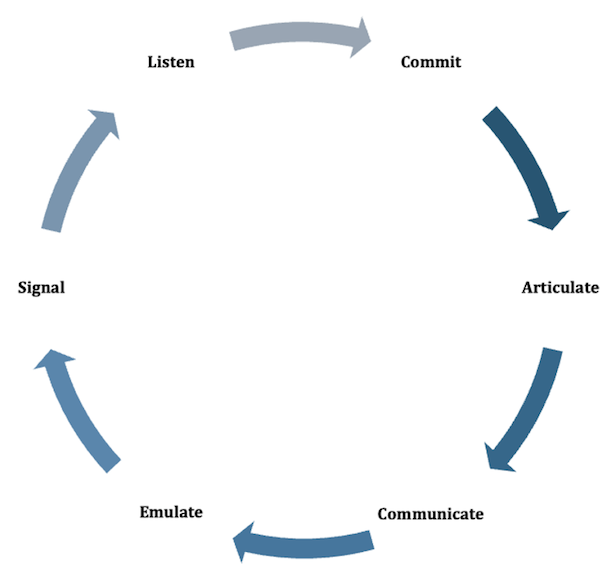
A Culture Shaping Framework
The Messy Reality
This looks sequential and easy in theory. But reality is messy. Startups discover mid-growth that their culture needs a reset. Established organizations find their aspirations mismatched with their lived culture. In most cases, culture is changed rather than built from scratch — and listening becomes the starting point, not the last step.
We open our minds with listening and feedback, not only to understand what’s working and what isn’t, but also to decipher what the current culture is. Our listening exercise may surface weakness in one or more of the steps that need to be addressed out of order. Let your context and data decide which step is most critical for you to tackle first.
In my conversations with the two CHROs, both concurred that leadership wasn’t willing to listen to uncomfortable truths. There was no acknowledgement of how culture was eroding their evolution and slowing down the growth trajectory of the organization. Why is that? Maybe because culture change slow, hard, consistent work that doesn’t show quick measurable results. Maybe because business leaders need to see quick results with each culture-building step. Maybe, the work starts with setting aside one’s ego and that can be very humbling. These are hypotheses, but it’s a question well worth asking.
Why do leaders find it easier to react to symptoms rather than strengthen the foundation?