
Things were going well. This leader was confident she had excellent relationships with her peers, her team and her manager. They could engage in lively debates. Mostly everyone agreed. The firm was doing well and there weren’t many high-stakes disagreements.
Then things changed. External competition and some leadership changes quickly turned the tide. Cost became a priority and resources became scarce. They had to do more with less and every team started to feel the pressure of showing measurable impact.
Engaged debates became defensive arguments. Different teams had access to more, less or different data and this created asymmetry.
Fear of taking even well-calculated risks became pervasive. Relationships started to fray, and the absence of a strong relational foundation became stark.
If this sounds familiar, you are not alone.
Strong relationships permeate organizational structures, systems and processes, filling hard-to-see gaps. In good times, they create an invisible synergy that fosters alignment and healthy conflict management. In hard times, they act as a shock absorber and improve resilience, trust and honest communication.
A report by the Center for Creative Leadership, titled The Space Between People: Building The Human Connections That Make Leadership Work At Scale, provides an insightful look at how connections and relationships are an invisible force for organizational well-being and success.
The report shows tangible business impacts when connection does not get built. Shared understanding of data diminishes, leading to different functions acting unilaterally and often at cross-purposes. Execution slows down because disagreements are not surfaced on time or not resolved constructively. Leaders spend emotional energy navigating the blame game, guessing whether they belong and striving for optimism. This erodes resilience.
What is connection? It is the feeling of being heard, the relational strength that gives us confidence to engage in constructive conflict and the feeling of belonging that allows us to express our thoughts without fear of judgment.
In a survey by Box of Crayons, 509 business leaders were asked which organizational impacts are most likely if their workplace fostered relational curiosity. Two findings stand out: 61% said employees would express ideas more freely, and 54% said it would increase their preparedness to diffuse conflict. Both point to the same underlying need: people want to engage, but only when the relational conditions make it safe to do so.
Relational curiosity is a fundamental way to build and maintain those conditions. It involves understanding the dynamic of a relationship and what that tells us. It is a powerful tool to deepen connections and forge or even repair them.
How and where does relational curiosity show up? Let us look at this competency at two distinct levels.
Organizations and Teams
While organizations and teams are collections of individuals, they can act like singular entities because the need for belonging can turn into groupthink. My framework to improve relational health for organizations and teams using curiosity, is a three-legged stool: Impact, Dynamics and Possibilities.
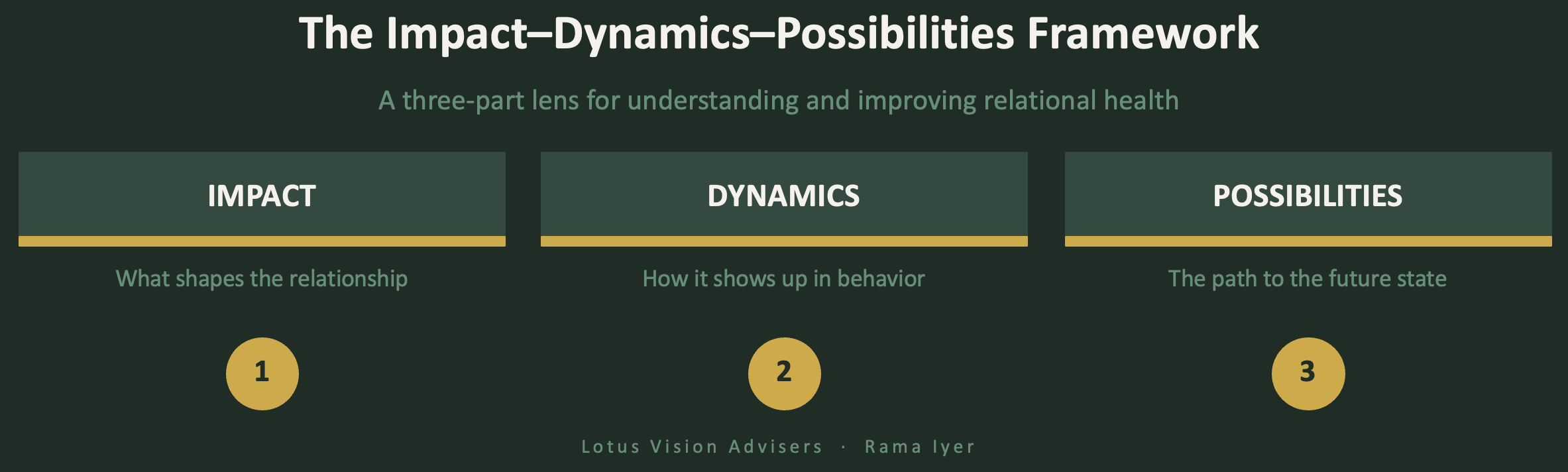
For ease of reference, I will use the term “entity” to refer to either an organization or a team throughout this section.
Inflection points in an entity’s life bring several challenges and also offer the most opportunities. The window of performance is usually small and the stakes are high.
One such inflection point is when relational conflict becomes apparent or is identified as a root cause impeding business outcomes. If two entities consistently work at cross-purposes, or if conflict exists at multiple leader levels, it is worth asking what that is telling us. Here are some questions that help get to the bottom of such a relationship:
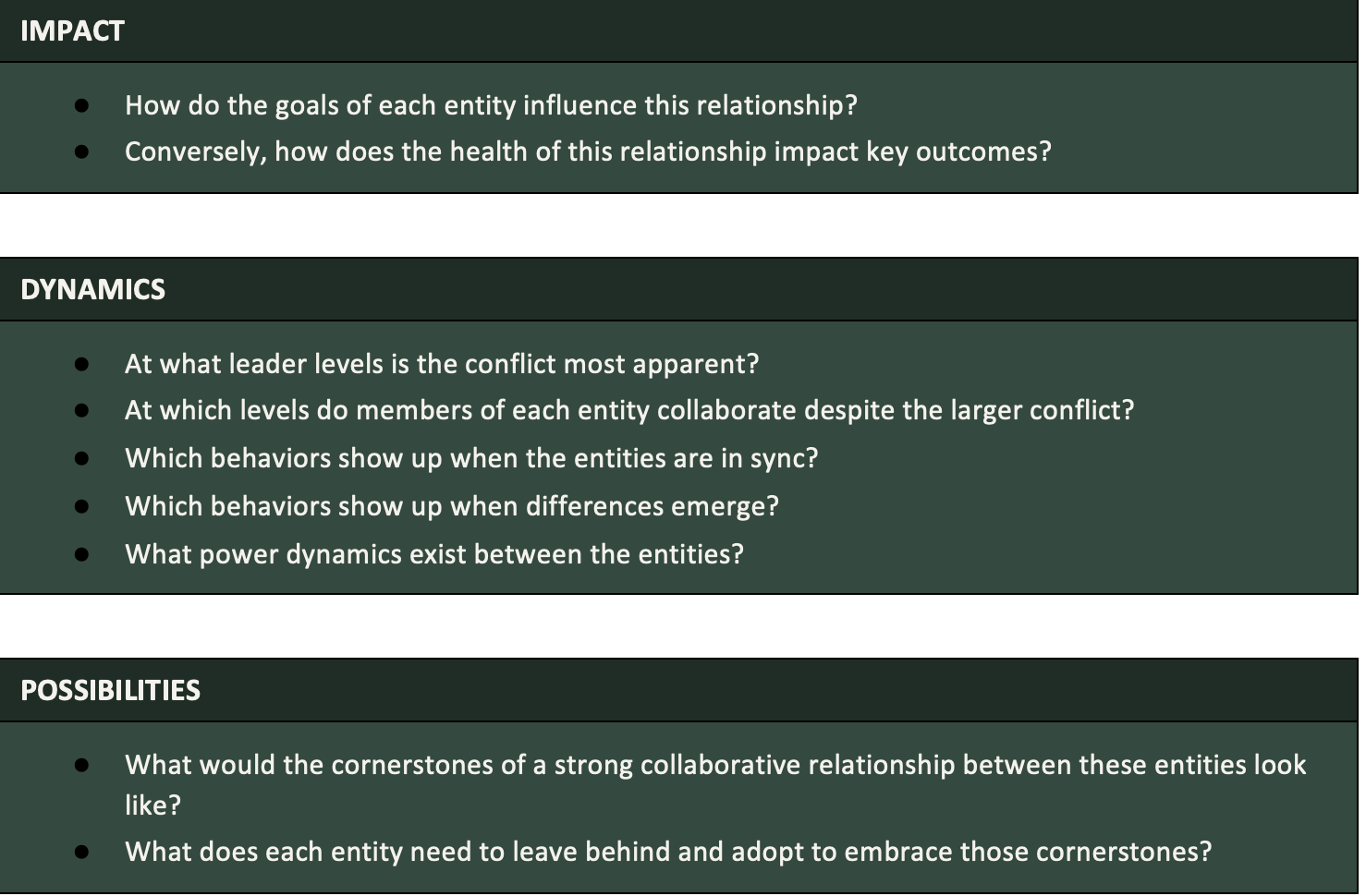
At one organization I worked with, we found consistent friction between the operations and sales functions. Taking a dispassionate view of the conflicts and helping the leadership teams stand in each other’s shoes, revealed that they were simply incentivized at cross-purposes. This was a simple fix on paper and a larger cultural shift in practice, but it was definitely fixable.
Another inflection point is an integration or transformation, where relational curiosity can be a potent tool that helps leaders get ahead of possible conflicts. This includes mergers and acquisitions at an organizational level and restructures at a team level. Using the Impact-Dynamics-Possibilities framework:
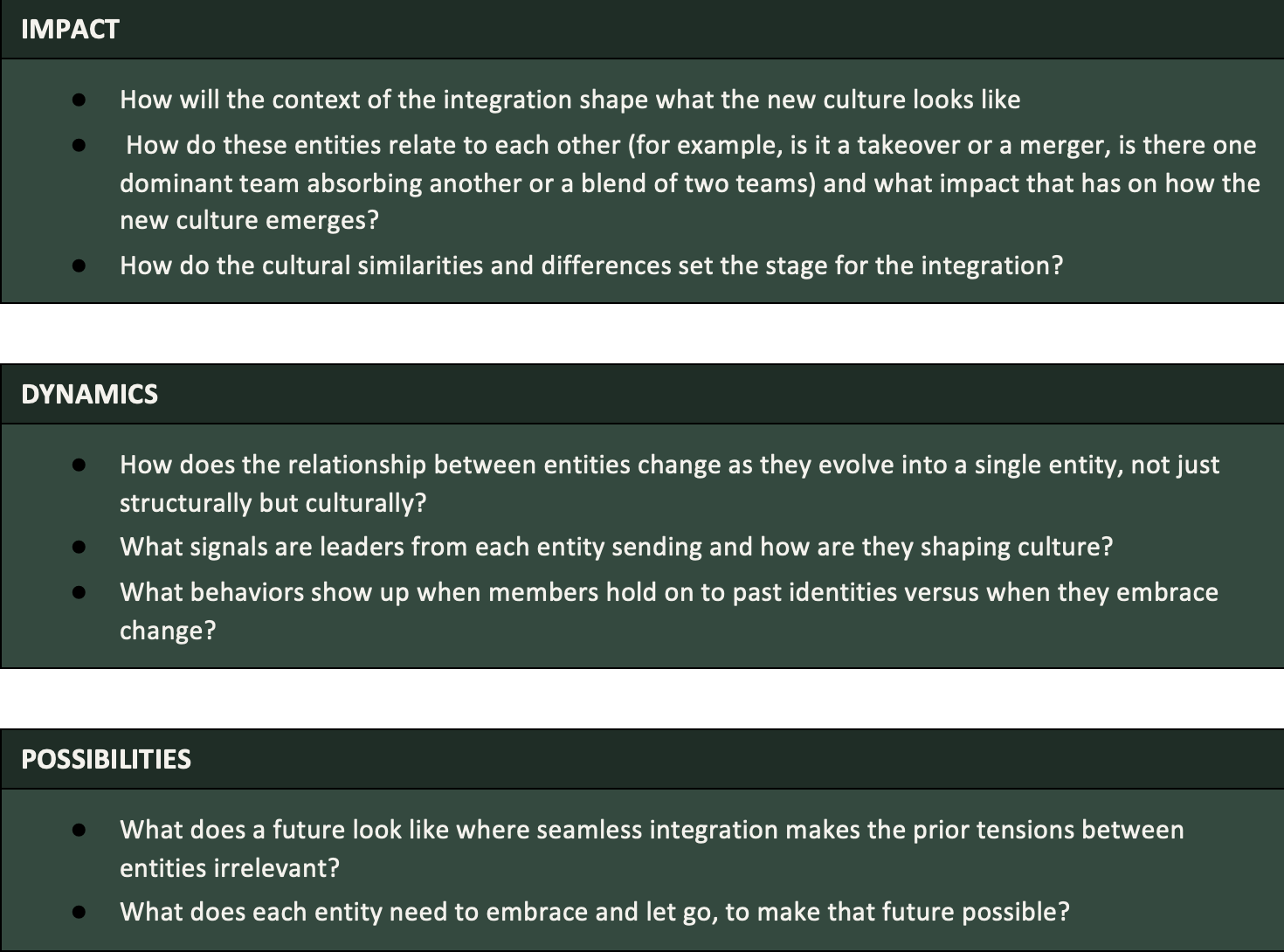
A brief note on an often-overlooked area of relational curiosity, specific to organizations: how an entity relates to its competitors. On the face of it, the answer seems simple: they compete, what else is there? In reality, it is more nuanced. Entities that truly leverage the potential of their competitive landscape ask themselves three simple questions:
● How do we consistently learn from competitors?
● How do our complementary strengths become collaborations?
● How can we come together to drive shared industry goals?
Individual relational curiosity
The frameworks above help entities step back and examine relationships as systems. But entities shift only when individuals do. The leader from the opening of this piece eventually found her footing again, not by restructuring her team or escalating the data asymmetry, but by getting curious about her individual relationships, one at a time. That is a different kind of work, and it requires a different lens.
At the individual level, things can feel very personal. Relationships can change over time without either person recognizing the shift. It is only when those shifts are manifested in outcomes that the rift or the synergy becomes palpable. For this reason, staying curious and having transparent conversations about the relationship are crucial to course-correct or maintain the trajectory.
There are four dimensions through which to explore a relationship:
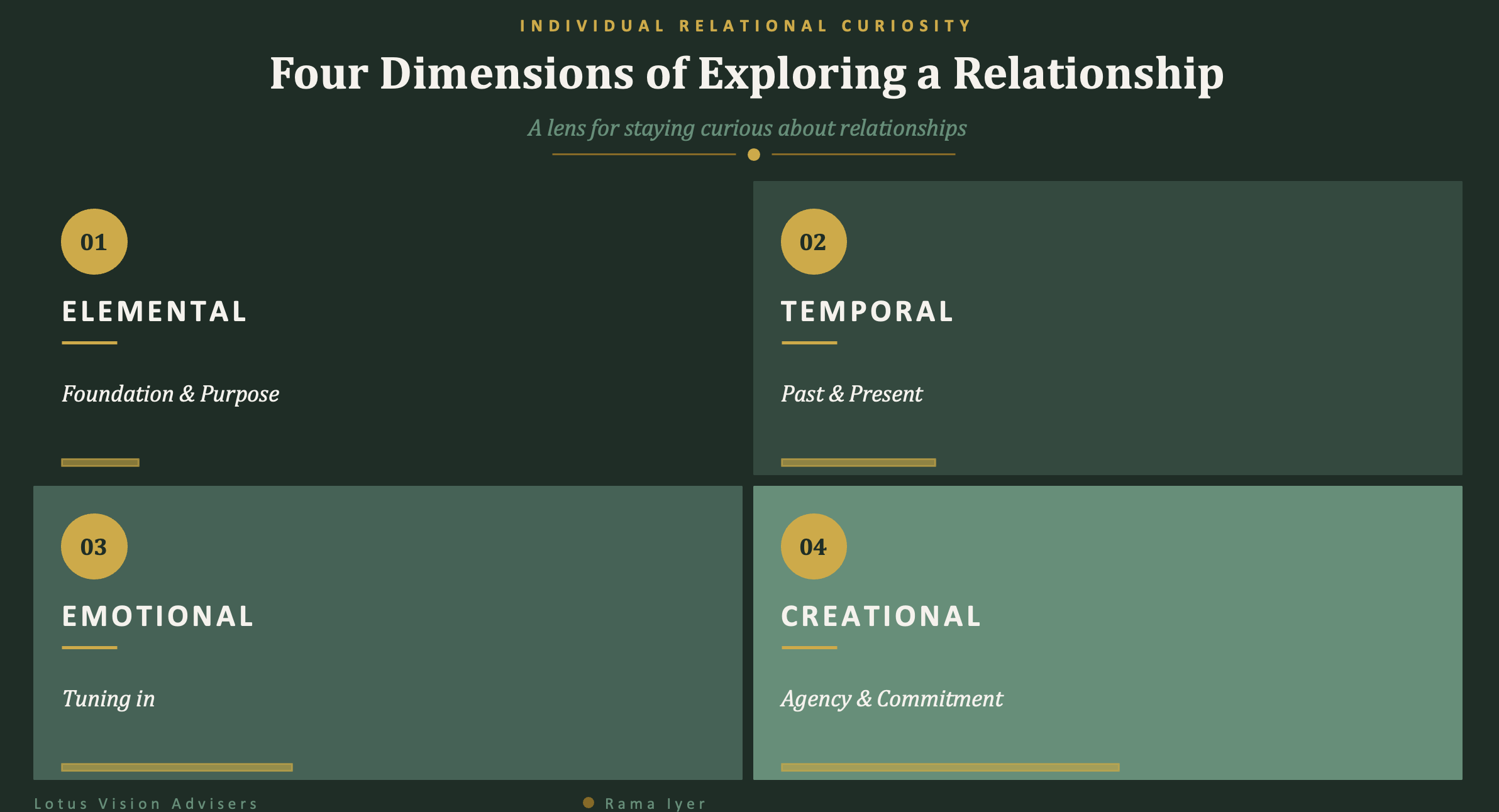
Elemental: The foundation and purpose of a relationship
Why this relationship came into being in the first place and why is it relevant now? What goals define each person’s interest in it? Are there power or interest imbalances? Does one person lean in more than the other?
Temporal: Separating the past from the present
The past: reflecting on how the relationship began, what changes it has gone through and why, gives context for the present state. For the here and now, noticing whether the tone or energy of recent interactions has shifted from an earlier baseline can signal that the relationship has moved, even when neither person has named it.
Emotional: Tune in to what is unspoken
A powerful way to get curious is to notice your own emotional cues and how the other person responds. What made them shut down? How do they change when you soften your expression or posture? How do your energies feed off each other?
Creational: Bringing agency
Both parties are responsible for the health of a relationship, and taking that responsibility seriously is a form of commitment. Questions like “When we disagree on this topic, what do you notice happens to the dynamic between us?” or “What do you think I am misunderstanding about your perspective right now?” or “How can I show up differently to make you feel more supported?” move a relationship from something that happens to us into something we are actively building.
The Creational dimension is perhaps the most radical of the four, because it insists that a relationship is not something that happens to us. It is something we are always shaping. The question is whether we are making it consciously.
That leader from the beginning of this piece did eventually get curious. The curiosity was not about the data asymmetry or the budget constraints. Those were real, but they were not the root. She got curious about the relationships that had quietly shifted while she was focused elsewhere. She started asking different questions: What changed for you when the pressure went up? What am I not seeing from where I sit? The debates did not disappear, but they stopped being wars over territory and became something more like navigating different vantage points aimed at the same destination.
Relational curiosity does not resolve every conflict or repair every rift. But it changes what you are doing when conflict shows up. Instead of bracing for impact, you get interested. And that shift, from defensive to curious, is often the thing that keeps a team, a partnership or an organization from breaking under pressure.
The Practice
If relational curiosity can be this beneficial, what stops us from practicing it?
The frequent refrain is time. In a fast-paced environment of back-to-back 30-minute meetings, it is hard to make time for curious questions and thoughtful responses. Listening to act becomes a habit and listening to understand falls by the wayside.
Ego and fear are other barriers. Curiosity takes humility and the openness for answers that are uncomfortable. It also puts some responsibility on us to act on what we hear. Without that, it is simply a check-the-box exercise that erodes trust.
If you have been giving yourself some or all these reasons for not getting curious about a relationship, try these three simple tips to make a start:
● Start small and relatively safe: Take a relationship that still feels somewhat robust but has not received investment lately. Notice what has fallen away in the absence of nurture. Try to have a conversation using the four dimensions of exploring the relationship. Build your confidence before you tackle a high-stakes relationship that is fraying.
● Journal for clarity: Reflect and write down your reflections after each meeting. The first few instances of leaning into curiosity can feel overwhelming. Writing quiets the mind and helps you unravel the knots. What felt natural and what was uncomfortable? What changes did you notice in the relationship after each meeting? Which outcomes shifted?
● Prioritize: The time constraint is real. Prioritize which two most critical relationships you want to repair and build more time to invest in them, going deep with curiosity. For the rest, one curious question per conversation is enough to keep the relationship alive.

If this resonated, forward it to a leader in your network who navigates complex relationships. And if you have a story about a moment when relational curiosity changed a dynamic, I would love to hear it in the comments.